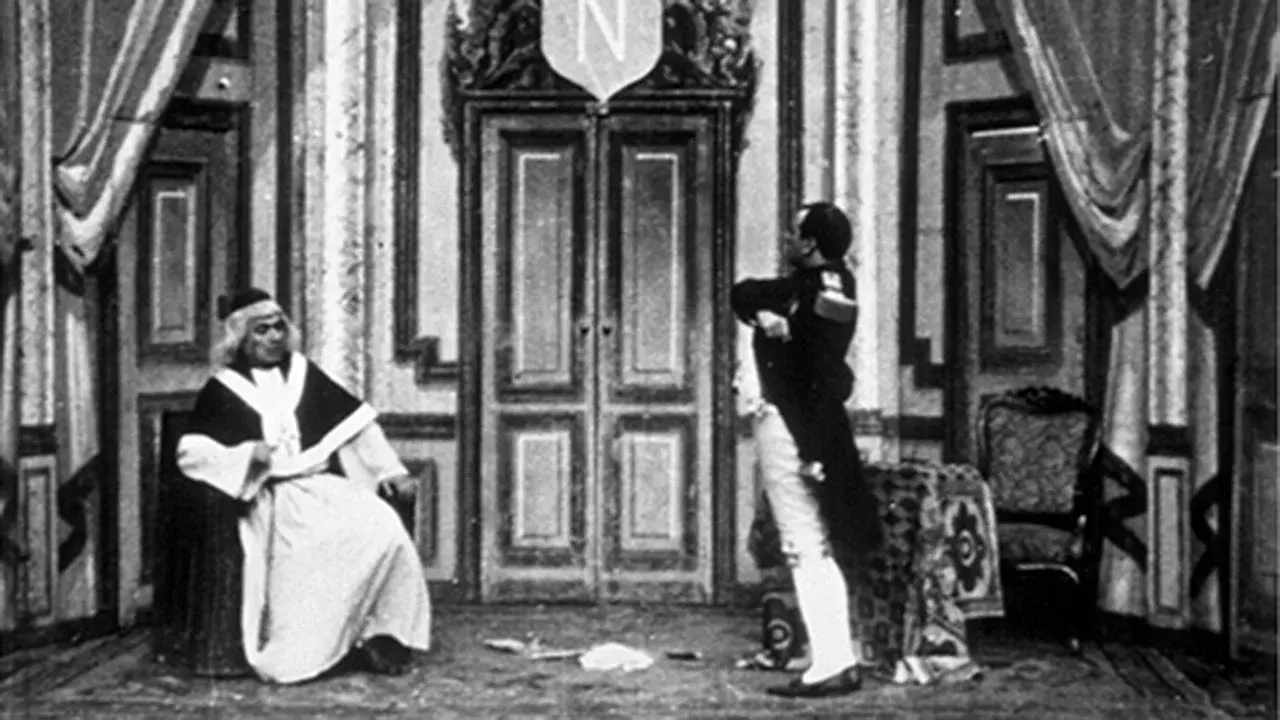
Interview Between Napoleon and the Pope
Original Title: “Entrevue de Napoléon et du pape”
Overview
This reconstruction refers to a meeting that allegedly took place on 25 November 1804 at Fontainebleau between Pope Pius VII and Napoleon to discuss the coronation.
Key Film Crew
Production Stats
You May Also Like
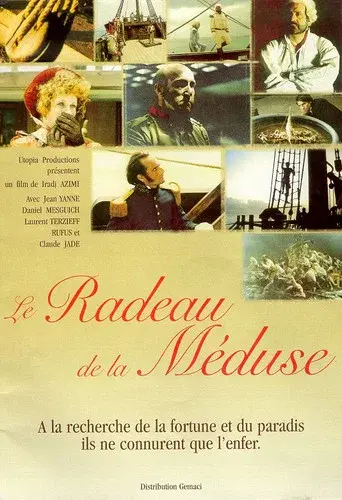
Iranian Iradj Azimi directed this French historical drama re-creating events depicted in the famous 1819 painting The Raft of the Medusa by Jean Louis Andre Theodore Gericault (1791-1824). The ill-fated voyage of the frigate Medusa begins when it departs Rochefort for Senegal in 1816. After striking a sandbar off the African coast, 150 civilians row safely to shore, but Captain Chaumareys (Jean Yanne) orders 140 soldiers and sailors onto a raft (minus supplies) and has it cut loose. Only 14 survive from the 140, creating a scandal back in France. Gericault (Laurent Terzieff) later talks to three of the survivors while researching his painting. Work on this film began in 1987, but sets destroyed by Hurricane Hugo caused delays, so the film was not completed until 1990. However, it then remained undistributed until an incident in which writer-director Azimi slashed his wrists in front of French Ministry of Culture officials.
Le radeau de la Méduse

Emy, a mature teenager, wakes up disoriented, after a tumultuous night. Her current state pushing her to (re)discover her body generates a shocking observation… Having no memory of the day before, she immerses herself in the depths of her memory with the help of her best friend, Lola. Through this retrospective, Emy is not only seeking the truth, but also confronting the vices of society…
Last Night

A distinguished military leader whose reign was touched by great scandal, shocking betrayals and rousing victories. A simple shepherd boy chosen to be king, under the watchful eyes of prophet Samuel.
David

In 19th-century France, doctor's wife Emma Bovary seeks to escape her dull provincial life through various extramarital affairs and extravagant spending, leading to tragic consequences.
Madame Bovary

A 19-year-old searches for her twin brother after he runs away from home, following a fight with their father.
Don't Worry, I'm Fine

From the mean streets of the Belleville district of Paris to the dazzling limelight of New York's most famous concert halls, Edith Piaf's life was a constant battle to sing and survive, to live and love. Raised in her grandmother's brothel, Piaf was discovered in 1935 by nightclub owner Louis Leplee, who persuaded her to sing despite her extreme nervousness. Piaf became one of France's immortal icons, her voice one of the indelible signatures of the 20th century.
La Vie en Rose

Reluctantly, a sulky adolescent returns to her parents' house for yet another boring summer vacation, dabbling in desire and the art of desirability, eventually mixing reality with vision, caged fantasies with the fierce female sexuality.
A Real Young Girl

A group of teenagers living in a housing project in the outskirts of Paris rehearse a scene from Marivaux's play of the same name. Krimo is determined not to take part, but after developing feelings for Lydia, he quickly assumes the main role and love interest in the play.
Games of Love and Chance

In the wake of their parent's separation, three siblings spend the summer in the south of France with their estranged Grandfather. In less than 24 hours, a clash of generations has occurred between the teenagers and the old man. During this turbulent summer, both generations will be transformed by one another.
My Summer in Provence
A commanding officer defends three scapegoats on trial for a failed offensive that occurred within the French Army in 1916.
Paths of Glory

During Napoleon's victorious campaign in Germany, the city of Kolberg gets isolated from the retreating Prussian forces. The population of Kolberg refuses to capitulate and organizes the resistance against the French army, which immediately submits the city to massive bombardments.
Kolberg

Two couple of friends, one very rich, the other almost homeless, decide to go on Holiday. Julie, a single mother, joins them too. Once at seaside, it starts a complicate love cross among them that will involve also a transsexual, a jealous brother, a Latin Lover and another nervous stressed couple. Not to mention about the daughter of one of them that is secretly in Chicago with one of her father's employees... At the end of the summer, all of them will join the same party...
Summer Things

The story of an unruly class of bright, funny history students at a Yorkshire grammar school in pursuit of an undergraduate place at Oxford or Cambridge. Bounced between their maverick English master, a young and shrewd teacher hired to up their test scores, a grossly out-numbered history teacher, and a headmaster obsessed with results, the boys attempt to pass.
The History Boys

After marrying a successful Parisian writer known commonly as Willy, Sidonie-Gabrielle Colette is transplanted from her childhood home in rural France to the intellectual and artistic splendor of Paris. Soon after, Willy convinces Colette to ghostwrite for him. She pens a semi-autobiographical novel about a witty and brazen country girl named Claudine, sparking a bestseller and a cultural sensation. After its success, Colette and Willy become the talk of Paris and their adventures inspire additional Claudine novels.
Colette

A story about bunch of people who live in a town in provincial France. At the center of it all is Pierre, a conceited and vain bisexual musician in his late teens who acts as a magnet, to varying degrees, for a whole array of characters - from his sister Lucie, with whom he has a heated incestuous relationship, to a city councilor with whom he participates in gay orgies. When Pierre turns up dead, Lucie investigates the reasons for his demise and charts the network of sadomasochistic relationships that crisscross the town.
One to Another

May 10th, 1981. François Mitterrand is elected President of the Republic. The “soviet tanks” supposedly coming upon the Champs-Élysées dressed in red, feared by some, did not march. Serge Moati takes a personal look at this episode, focusing on the relationship the president had with television, that he witnessed and played a role in.