
Overview
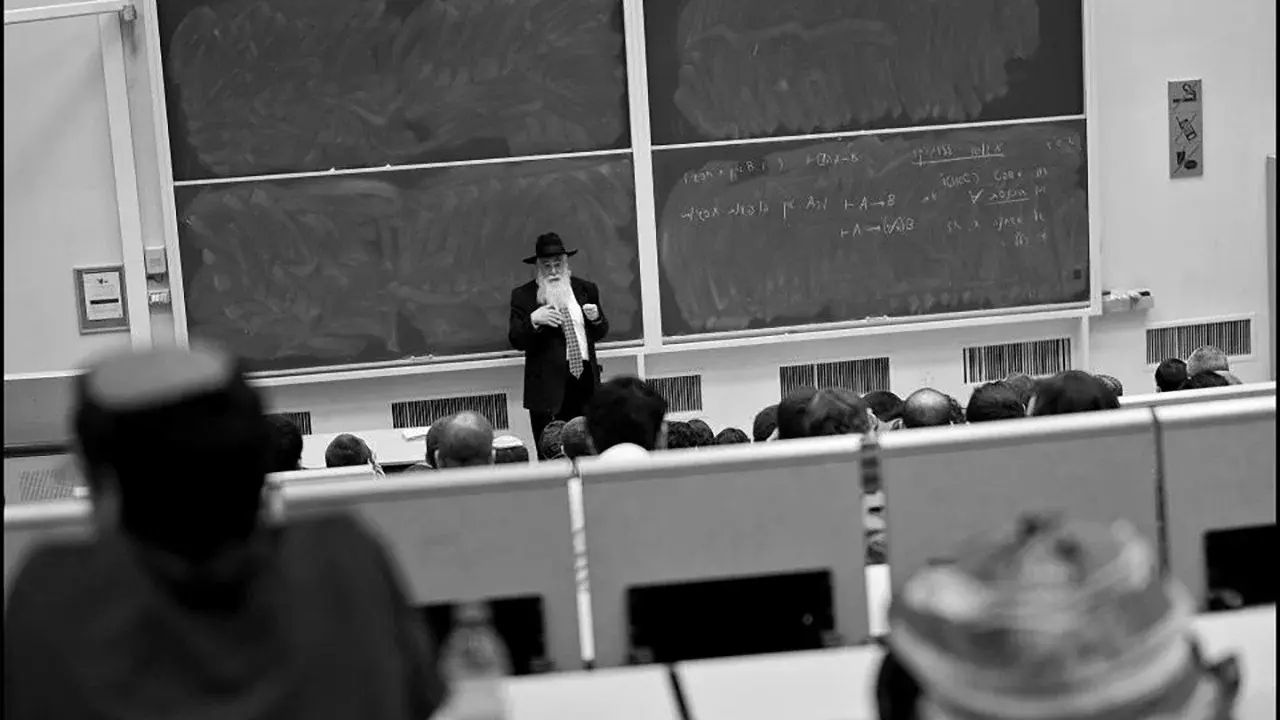
In April 1969 Ilya (Eliyahu) Rips, then a young student of mathematics, tried to burn himself in a public square in Riga, Latvia protesting against the Soviet invasion of Czechoslovakia. He was stopped and eventually sent to a psychiatric hospital for two years. Thanks to international pressure from the mathematical community in 1972 he was allowed to emigrate to Israel. Now he is considered one of the most brilliant mathematicians in the world. At the same time, for most people familiar with his name, Rips is first of all associated with the development of the so called Bible Code – a mathematical program allegedly helping to decipher hidden messages encoded in Torah – the Five Books of Moses. He is attacked by both the scientific and religious community, yet his research continues.
Top Cast

Eliyahu Rips
Self
Key Film Crew
Production Stats
You May Also Like




A follow-up to "The Leader, His Driver, and the Driver's Wife", about the history of the far-right group AWB and its leader Eugene Terre'Blanche.
His Big White Self

RAISING RENEE is the story of a family's remarkable response to being broken apart and rearranged after nearly 50 years. The film explores deep themes of family, race, class and disability through the interplay of painting, cinema and everyday life. Produced and directed by Oscar nominees Jeanne Jordan and Steven Ascher, RAISING RENEE is the third part of a trilogy about resilient families that includes their acclaimed feature documentaries So Much So Fast and Sundance Grand Jury Prize winner Troublesome Creek. RAISING RENEE is about a unique group of women, the tenacity of family bonds and the power of art to transform experience into something beyond words.
Raising Renee
chronicles the life of Josh Keogh, a 15-year-old whose family was shattered when his father died of liver cancer only six weeks after being diagnosed. Filmed over the course of a year, the documentary begins only a few months after James Keogh's death and candidly captures the emotions the grieving son hid from his family and friends.
Love, Josh
Iran, 2008. As President Mahmoud Ahmadinejad's motorcade creeps through the teeming streets of Qom Shrine, thousands of people jam hand-written letters into the hands of his handlers. Hearing their President deliver a speech is a thrill, but more promising to these men and women is the hope that their letters - expressing pleas for loans, medical attention, housing and jobs - will be answered. Since his 2005 election on a populist, "man of the people" platform, Ahmadinejad has encouraged Iranians to send him such letters; according to a staff member, he has received about 10 million of them, and has been able to respond to nearly 76 percent. In one letter, a 16-year-old boy says his family has no money and goes to bed hungry every night. According to the staff member, the boy will be helped. As other letters are read, the worker says that "In Islam, charity is a necessity."
Letters To The President

Uplifting tale of Staten Island woman who creates modern underground railroad and rescues 2,000 dogs condemned to death in Amish Country puppy mills. The film chronicles Laura F on her weekend rescue missions to Amish Country. With her Brooklyn mom and Staten Island girl friends by her side, Laura embarks on a four-year odyssey to rescue dogs from the hellish conditions of Amish puppy mills. The film follows four of the dogs from the time their lives are spared until they are nursed back to health and placed with their forever families. We see the dogs leave the cages where they have spent their entire lives and watch these dogs, who were given up for dead, transform the lives of the people who adopt them.
Madonna of the Mills

Rhythmic composition of moving photographs of cyclists in Amsterdam, ‘set’ to Vivaldi’s The Four Seasons.
Bicycle
The point of departure for this film is the 1981 composition De Tijd by Dutch composer Louis Andriessen. Van der Keuken leaves the music undisturbed as an autonomous soundtrack and has the images engage in a sort of battle with it. These images are associations, fragments of events, scenes and situations. The film is preceded by a text by Bert Schierbeek.
Time

Manual Scavenging is an all India Phenomenon. However, the Government of India is kind enough to enact Prohibition of Employment as Manual Scavengers and their Rehabilitation Act and implementing many schemes. But none of them failed to work as the caste system is paramount in the so called democratic constitutional India. This film Kakkoos elaborates on the deplorable status.