

Overview
After Burindh, a Thammasat university student has escaped from the 6th October massacre by jumping into the Chao Phraya river, he becomes a goby fish with golden skin, and voyages through the memories of his own.
Key Film Crew
Production Stats
You May Also Like
A young Polish filmmaker sets out to find out what happened to Mateusz Birkut, a bricklayer who became a propaganda hero in the 1950s but later fell out of favor and disappeared.
Man of Marble

A failed writer relives the past since he's unable to write something new. His search for inspiration will make him delve into his mind and face his internal conflict.
Auto-hipnosis



In April 1985, I started to make a film with my friend Kamioka as the main character. But even after three months, the whole film was still unknown. I started to work alone with the camera. One day, the rabbit he keeps at home gives birth to a stillborn baby. As he buries her under a tree in the garden, it made me think of his father, who died the year before. He is no longer with us, but only the gaze he left behind. And so I set off on a journey. In a town in the Hokuriku region, he met a woman who once appeared in one of his films. When I dozed off on the train to Tokyo, she appeared to me in a dream and tells me that I will soon find the exit. Back in Tokyo, I told Kamioka that I'm going to start filming again. I came back into the room, turned on the microphone and pressed the flame against the lens.
Guiding Star
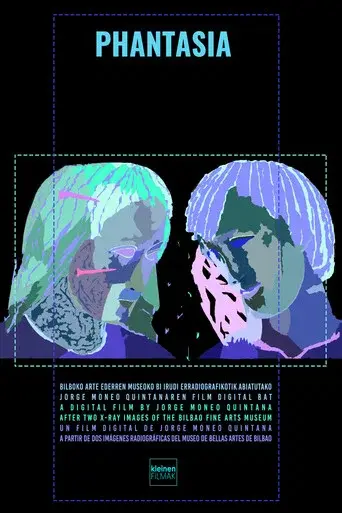
X-ray images were invented in 1895, the same year in which the Lumière brothers presented their respective invention in what today is considered to be the first cinema screening. Thus, both cinema and radiography fall within the scopic regime inaugurated by modernity. The use of X-rays on two sculptures from the Bilbao Fine Arts Museum generates images that reveal certain elements of them that would otherwise be invisible to our eyes. These images, despite being generally created for technical or scientific purposes, seem to produce a certain form of 'photogénie': they lend the radiographed objects a new appearance that lies somewhere between the material and the ethereal, endowing them with a vaporous and spectral quality. It is not by chance that physics and phantasmagoria share the term 'spectrum' in their vocabulary.
Phantasia

On the way to the supermarket, a family discusses the history of the old zoo in Poznan, Poland, and Darwin’s absurd fear of peacocks.
Afraid of Peacock

In 1952, Amédée took his own life by jumping into the Seine. No one knows the reason for this tragic act. His story comes to us in bits and pieces.
Amédée

After seven years in prison, a female student in Tehran is hanged for murder. She had acted in self-defence against a rapist. For a pardon, she would have had to retract her testimony. This moving film reopens the case.
Seven Winters in Tehran

In 1989, a woman writes a letter to her mentor. She reminisces about a life-changing campaign they spearheaded to save a historic home, Irving Gill's Walter Luther Dodge House in Los Angeles, twenty years prior.
Dear Esther

The documentary recounts the world's first nuclear attack and examines the alarming repercussions. Covering a three-week period from the Trinity test to the atomic bombing of Hiroshima, the program chronicles America's political gamble and the planning for the momentous event. Archival film, dramatizations, and special effects feature what occurred aboard the Enola Gay (the aircraft that dropped the bomb) and inside the exploding bomb.
Hiroshima


“Archeology” and “Archive” share the same roots. Both words come from “Arkhé”, the Greek word for “origin”. In the ruins of buildings, lost forever by earthquakes, as in the depth of the archives, we dig. What happened the morning of the big earthquake? The morning of September 19th 1985 is fading away in our memories. These recordings have never been seen. Unedited images of the catastrophe dug out by the archaeological adventure of an archivist that suffered with them. He dug and suffered until he could no longer see.
